AI Code Editors & IDEs: Complete Collection, Reviews & Guides

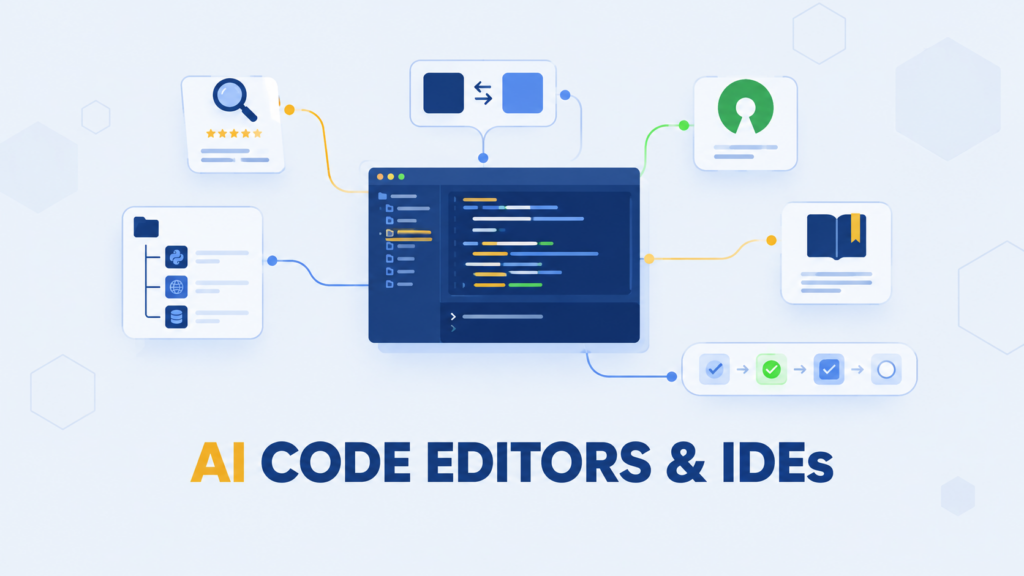
AI code editors and IDEs are not interchangeable products. The category covers tools that replace your editor entirely, tools that add AI to the environment you already use, and tools that assist from the sidelines. That range is what makes choosing one harder than it should be. This Hub gathers every resource we’ve published on the topic: individual reviews, direct comparisons, curated free and open-source lists, and workflow-based recommendations. Readers new to the field can start with AI Code Editor before returning to the specific pages below.
Choosing Between AI Code Editors, IDEs, and Coding Assistants
AI Code Editors and Development Environments
The cleanest way to sort this category is by what each product asks you to give up. Full AI IDEs replace your editor: new interface, new extension system, new settings. AI-augmented editors keep what you have and add capabilities on top. Knowing which change you’re willing to make narrows the list faster than any feature comparison.
When an AI Coding Assistant May Be Enough
Not every developer needs to switch environments. If your current editor already fits how you work, an assistant can layer AI onto it without disrupting anything else. The category is covered in AI Code Assistants, and Cursor shows what a full AI-first environment looks like in practice.
Before comparing tools: decide whether you’re replacing your environment or extending it. That single choice narrows the field faster than any feature list.
AI Code Editor and IDE Reviews
Every review below looks at who a tool is built for, how it fits an existing workflow, what it does well, and where it stops. Feature counts can be misleading, and a tool with fewer features that fits your process will outperform one with more features you never touch. Where a review relies on documentation or user reports instead of direct testing, the review itself says so. The order here reflects publication timing, not ranking.
- Kiro is AWS’s AI IDE built around spec-driven development, where requirements and design documents steer the generated code. Teams that prefer structured workflows over ad-hoc prompts get the most from it.
- Built for teams working inside large, mature codebases, Augment Code fits AI assistance into existing workflows rather than replacing them.
- If you already work inside JetBrains IDEs, JetBrains AI Assistant plugs directly into that ecosystem. Portability to other editors is limited by design.
- Replit runs the entire development cycle in the browser, from prompt to deployed application. Cloud-first prototyping and collaboration are its strengths; local-first development is not.
- For daily coding help without a full environment swap, Blackbox AI works through browser and editor integrations. It behaves like a coding assistant, not a standalone IDE.
- Devin Desktop is the environment formerly known as Windsurf. Its editor experience and agent-management workflows take center stage in the review, along with how it compares to other AI-native editors.
- Amazon Q Developer is AWS’s developer tooling product, with integrations across IDE and CLI environments. Verified availability and current IDE support are worth checking before adoption.
- Across many languages and a long feature list, AskCodi remains a lightweight daily coding companion rather than a full environment replacement.
Enterprise buying criteria look nothing like individual tool selection, so Best AI Coding Assistants for Enterprise Teams lives on its own page. What follows here is a shift in format: reviews evaluate one product, comparisons pair two.
Compare AI Code Editors and Development Tools
Already narrowed things down to two? Direct comparisons settle the last mile faster than reading two full reviews side by side. None of them crown a universal winner. Each one shows where the tools diverge, which is stronger for which kind of developer, and where the trade-offs land.
- Augment Code vs Kiro pits two philosophies of AI-assisted development against each other. One leans on structured, spec-driven workflows; the other fits AI assistance into the codebase you already have.
- For developers deciding how deeply AI should be embedded into their current environment, GitHub Copilot vs JetBrains AI Assistant is the head-to-head to read. Each side has an individual review too: GitHub Copilot and JetBrains AI Assistant.
- Replit vs Blackbox AI weighs cloud-first application development against a lighter assistant that works inside tools you already use. Two very different ideas of where AI should sit in the process.
Order matters here: comparisons settle a decision you’ve already narrowed. Curated lists help you discover the field before narrowing it. Read them in the wrong order and both waste your time.
Free and Open-Source AI Code Editors
Two products can both be labeled “free” and mean entirely different things. A free tier may cap usage, exclude premium features, or restrict commercial deployment. Open source is a separate claim, and one that says nothing about whether the tool is easy to use or free of paid model costs.
For a side-by-side of free tiers and what each one excludes, Best Free AI Code Editors does the work. Where source access, licensing, and customization matter more, Best Open Source AI Code Editors is the right list. Verify which components are actually open source inside each product before leaning on the label.
Teams that would rather extend the current setup than replace it will find a parallel discussion in Open Source AI Coding Assistants. From here, the next section narrows toward specific workflows.
Find an AI Code Editor for Your Workflow
Two developers can open the same AI editor and get very different results. Fit depends on the work, not the language label on the box.
Worth knowing: “Python support” and “web support” are broader labels than they sound. Two projects in the same language can demand very different things from the same editor.
Python and Data Work
Python projects vary more than the label suggests. A single-file automation script and a multi-file application with tests have little in common, and data-heavy work sits in a third category altogether. How a tool handles existing code, multi-file navigation, and debugging usually decides the fit. Details are in AI code editor for Python, and Best AI SQL Tools for Data Analysts covers the database-facing side. Built-in SQL generation, be aware, is not standard across AI editors.
Web and Backend Development
Web developers care less about language features and more about project awareness: framework context, component structure, and how the editor reasons about the backend behind the UI. See AI IDE for web development, and Best AI DB Tools for Backend Devs when the backend works directly with a database.
AI-Assisted Coding Workflows and Guides
Choosing an editor is the easy part. What actually shapes your results over the next few months is how you work with AI once it’s running, not which subscription you chose.
- What Is Vibe Coding unpacks prompt-driven development as a working method, including where it breaks down.
- As assisted coding gives way to workflows where agents handle multi-step tasks, AI Coding Agents explains the model in depth. This Hub stays focused on editor and IDE selection; that page picks up where this one leaves off.
Practical questions about offline behavior, data handling, and cancellation terms come up in the FAQ below.
Frequently Asked Questions
Can I use more than one AI code editor on the same project?
Yes, but conflict risk grows with every tool watching the same files. Extensions, settings, and concurrent edits from multiple assistants can overwrite each other. Keep a single primary environment and treat any second editor as a reference or sandbox, not a true parallel setup.
Can I use an AI code editor without an internet connection?
Sometimes. Most AI features depend on cloud-hosted models, and even editors with local-model support often need a connection for agent mode or settings sync. A few tasks may run offline, but the scope depends on the product and should be tested against your own workflow.
How can I check whether an AI editor uses my code to train its models?
The answer lives in the provider’s data-use and retention terms, which typically differ between free, paid, and enterprise plans. Look for explicit opt-out controls and confirm they apply to your specific plan tier. The same product often applies different defaults to different customers.
Can AI code editors use custom models or API keys?
Support varies by product. Some accept your own API keys from providers like OpenAI or Anthropic. Others support local models through Ollama or LM Studio. A few restrict you to vendor models only. Verify supported models and plan-level limits before choosing a tool for this reason.
Do AI code editors work with Git, automated tests, and CI pipelines?
Compatibility depends on the editor’s integrations and your existing workflow, but the general answer is yes. Generated changes still need to be reviewed, tested, and validated through your normal CI pipeline. Treat AI-generated commits the way you’d treat any contributor’s pull request: review before merge, not after.
Can AI-generated code be used in a commercial product?
It depends on three things: the applicable service terms, the licenses of any dependencies in the generated code, and your jurisdiction. None of this is legal advice. Review the vendor’s terms and, for commercial-scale use, consult legal counsel. Ownership guarantees vary by provider and are rarely universal.
What happens to my files and workspace if I cancel an AI editor subscription?
Local files stay on your machine. Cloud-hosted projects, AI features, and synced workspace settings usually deactivate when the subscription ends. Export your work and check the retention policy before cancelling; some products delay deletion, others cut cloud access immediately.
Small practical checks about offline scope, data terms, plan limits, and export options turn a promising tool into a workable one.
Final Thoughts on AI Code Editors & IDEs
The right editor isn’t the one with the most features or the loudest reputation. It’s the one that fits your projects, your constraints, and the way you actually work. Reviews and comparisons only become useful when you read them against a real task you’re trying to finish. Product names, pricing, and capabilities change quickly, so this Hub will keep being updated as the field evolves. Pick a tool, run it on real work for a week, and let the results decide.